Friday, September 26, 2014

"From Imagination to Freedom: Maroon Strategies in the Visual Arts" presentation

I was invited to participate in a roundtable panel discussion organized by the VICCC (Virgin Islands Caribbean Cultural Center) and SUCCEED (St. Croix Unified for Community, Culture, Environment and Economic Development, Inc). Each presenter was asked to talk from the perspective of their field and work as it relates to the maroons on St. Croix. Other presenters were Dr. George Tyson (historical), Dr. David Goldstein (archeological), Dr. Chenzira Kahina (spiritual), Dr. Olasee Davis (ecological). I was honored to be part of such an event and illustrious panel.  I was asked to give my perspective from the visual arts. Here is an excerpt of the beginning:

From Imagination to Freedom: Maroon Strategies in the Visual Arts
presented by La Vaughn Belle
September 26, 2014 at the University of the Virgin Islands
SUCCEED & VICCC panel discussion on the Maroons of St. Croix

Slide 1:
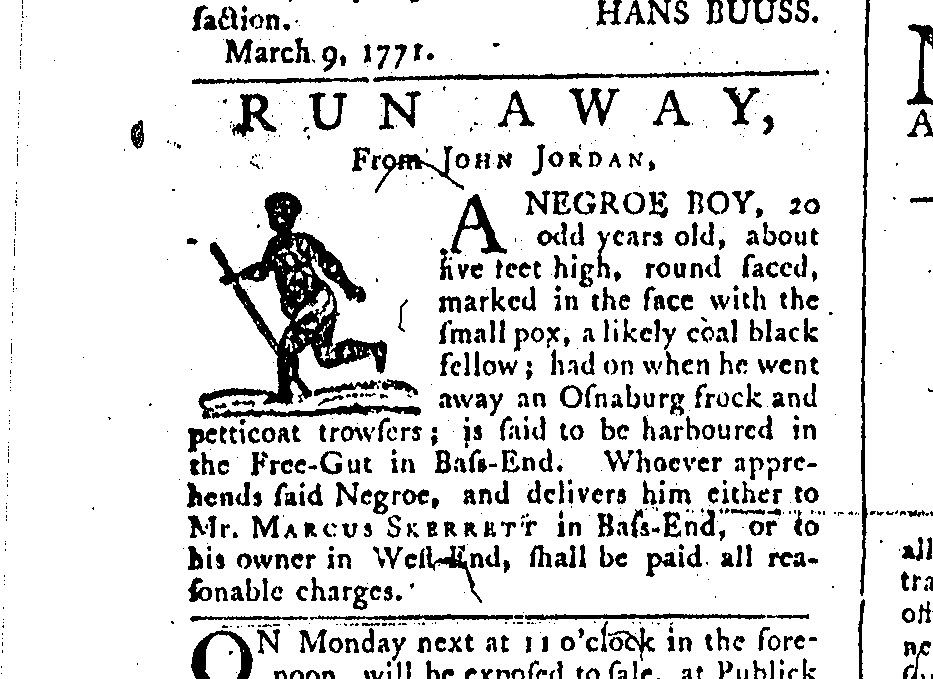
Runaway to Free Gut, Christiansted 177108232012_0000.jpg

Slide 2:
“Secrecy, cunning, fugitive sensibilities are critical to the success of an artform’s craft.  For art protects its own sense of order, undercover, and ambushes society from under that cover of secrecy.”-Rex Nettleford

In thinking about colonialism and it’s progenitor, slavery, the maroons emerge as the rebellious offspring, existing both outside and inside a system of brutality and exploitation. As in elsewhere, in the island of St. Croix the maroons had to develop a series of strategies for survival that included: secrecy, cunning, fluidity and multiplicity of meaning, appropriation and imagination. All of which are also strategies often employed by visual artists. For my presentation I plan on focussing on these strategies utilized by the maroons for both survival and resistance and how they apply to the visual arts by using some examples in my own work.

Slide 3:
The Harder They Run, 2001, acrylic & pencil on 4 panels of masonite, 32”x14”, collection of Gustav James
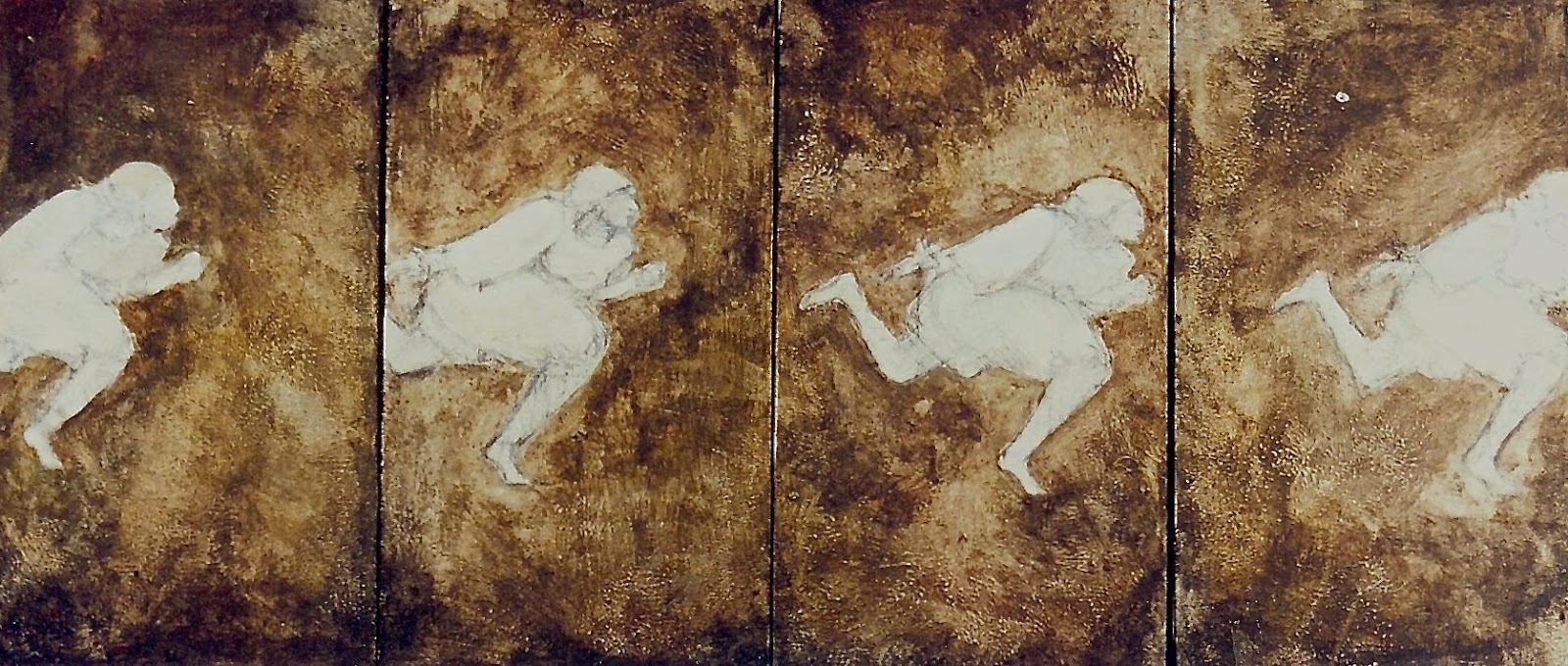
the harder they run, 2001 (acrylic and pencil on 4 panels of masonite).jpg


In one of my earlier works, The Harder They Run, I am directly working with an image appropriated from a *lithograph depicting runaway slaves. The maroons, as artists, would have had to be quite adept at taking symbols, images, ways of being, speaking and doing and using them in different contexts to create their own meanings. In doing so, there would also be a multiplicity of meaning, textured layers of interpretations of symbols, gestures and images. This piece also speaks to the concept of fluidity of self and identity as the panels reference frames of motion, similar to someone trying to capture a moving image by taking a series of photographs. The play of words in the title “The Harder They Run” from the Jamaican film and title track “The Harder They Come” also speak to the possible futility or frustration in the process of sovereignty and/or in the process of the dehumanization of enslavement. For the verse continues “the harder they come, the harder they fall”, further opening up the possibility of interpretation as one wonders, who is “they”?, the colonial authority? or the maroons?

If you would like more information about this presentation or would like to invite me to give this talk please contact me at studio@lavaughnbelle.com.

Friday, July 4, 2014

"Big Art Small Place" written by David Knight, Jr


If you happen to be traveling on Caribbean Airlines or Air Jamaica this month look out for an article I have in the inflight magazine, Caribbean Beat, which is also the region's most widely distributed magazine. Written by St. John writer David Knight and portrait photos taken by Quiana Adams (of Q Studios), it is a nice profile of my work. Here is an excerpt:

Her work makes a strong argument that “small island” art should be as much about deconstruction as it is about decoration. She is fascinated by the things we often take for granted: the cultural artifacts, practices, and locations that make our homes distinct. In this way, Belle’s investigations remain grounded in everyday life in St Croix. But despite a self-professed interest in the provincial, her work fixes its gaze outwards. Informed by a Pan-Caribbean heritage (her parents moved to the Virgin Islands from Barbados and Tobago), an international education in New York City and Cuba, and the multi-layered history of St Croix (the island has changed colonial hands seven times), Belle is very much in dialogue with the world.
A tension between the cosmopolitan and the local is a key feature of our times, and one might be forgiven for pointing out that, in small communities, critical discourse does not always flourish. In such an environment, contemporary artists can easily become frustrated by censorship, a lack of an audience, or both.

But La Vaughn Belle’s work contains nothing of this sort of cynicism: her environment is an abundance, not a lack. “The Virgin Islands is an amazing place to make art,” she recently wrote on her personal blog. “We are this small place in the [Jamaica] Kincaid sense of a small place, like many islands in the region. We are full of contradictions, insularities, and strange obsessions. We are still navigating our ‘coloniality’ in a post-colonial world.”

NB: this text is copyrighted, and only limited excerpting with full attribution is permitted. For licensing and reproduction permissions, please contact Caribbean Beat directly.

Saturday, April 12, 2014

Art VI Advocates

This weekend Priscilla Hintz Rivera with ART VI Advocates presented two amazing workshops at the Caribbean Musuem Center for the Arts on Saturday, April 12.

My take away quickly on the two workshops.

The Role of the Curator and Recent Shifts in Curatorial Practice presented by Cheryl Hartup
This was quite fascinating as Cheryl gave a historical analysis of the rise of the curator, when this term was first used, what it meant for the art world and how this role is conceived today. It was very interesting and informative.


Arts Marketing Strategies to Get Exposre For Your Work presented by Marta Mabel
Marta works in the Artist Assistance Program at the Museo de Arte de Puerto Rico. She is also an artist herself and this museum and program is dedicated to the development of Puerto Rican artists. It's quite amazing what this program is doing and how it has nurtured the artists and reshaped the art landscape in Puerto Rico. It was a very detailed workshop that addressed issues like how to inventory your artwork, the importance of being organized, how to get gallery representation and exhibits in museums. She provided sample of artist statements, bios, portfolios and solicitation packages for museum shows. It was great! And very needed as it was encouraging and supportive with the right "kick in the butt" attitude, like "get it together people!". Not that she said those things, but she did give a very matter of fact reality check that this is your career, your artwork, you need to value it, support it. No one else will if you don't first.

Personally it was perfect timing for me!
Special thanks to Priscilla Hintz for organizing this event!

Monday, March 17, 2014

"Losing Our Virginity: Contemporary Art of the Virgin Islands", Presentation at the Biennial Music and Arts Conference

The Virgin Islands is an amazing place to make art. We are this small place in the Kincaid sense of a small place, like many islands in the region. We are full of contradictions, insularities and strange obsessions. We are still navigating our "coloniality" in a post-colonial world. We are are in constant negotiation with our shifting identities. I wanted a space to talk the art that has happened in the past 20 years, the contemporary work that often gets misunderstood or neglected. I wanted to put them all together and look at them and think, ok, so what does this say about us as Virgin Islanders, as artists, as people?

So I have been working with this idea for about a year now, "losing our virginity", as a framework in thinking about contemporary art in the Virgin Islands. Slowly, inactively and used this conference at the University of the Virgin Islands as an opportunity to finally concretize these thoughts on paper.

Here is a an excerpt of this essay/slide presentation. Please contact me studio@lavaughnbelle.com if you are interested in learning more or would like me to give this talk.

Losing Our Virginity:
Contemporary Art of the Virgin Islands
written and presented by La Vaughn Belle, March 2014
(First presented at the Biannual Conference of Music and Art at the University of the Virgin Islands, St. Thomas Campus on March 17, 2014)


"One of the ways that Christopher Columbus' dedication to the Virgin cults of Mary and others is demonstrated is in the numerous islands he named after the Virgin.  From Santa María de Monserrate (Montserrat),  Santa María la Antigua (Antigua), Nuestra Señora de las Nieves (Nevis) to our own Santa Ursula y las Once Mil Vírgenes (The Virgin Islands) we see a particular narrative encoded with gender and power relations taking root.  Beginning with these early encounters and namings, the Caribbean continues to be associated with the myth of  a virgin paradise. This idea of a pristine geography that is uncharted, unexplored, and uncultivated is what motivated European exploration and subsequent exploitation. From ‘plantation pictures’ to the images of a picturesque tropical paradise much of the art from the Virgin islands is based on a particular framing as a space of desire with very particular positions of who is in power. This paper plans to outline a trajectory that begins with some of the earliest imagery coming out of the Virgin Islands that promulgates these colonial metaphors of virginity, order and conquest and highlight how artists have either replicated this colonial script or reinterpreted that narrative altogether. In many ways it is this critical discussion of the visual arts in the territory that is virgin. This uncharted analysis, is needed in an era where images increasingly displace words, but also because a better understanding of our visual arts history will lead to a better grasp of our cultural identity and development. This slide presentation and lecture is the beginning of what hopes to be a larger investigation into the visual arts of the Virgin Islands. I will focus on when I believe this “loss of virginity” occurred and the artists, their work and other other factors that contributed to this phase in development of our visual culture

Primarily, it is important to note that the concept of virginity is a social construction. In actuality there is no concrete agreed upon definition of virginity. It is not necessarily penile penetration of the vagina, nor is it necessarily the rupture of a woman's hymen. We then must consider that virginity is an imagined space in which a gendered conversation occurs.  It’s a frontier, whose crossing becomes a rite of passage. In the context of the Caribbean, virginity has become a visual metaphor to express a narrative of a vast wilderness, unbroken forests, a pristine paradise and innocent natives and a space where others could exact their imagination, their desires, dreams, lusts, etc.. In the Caribbean virginity is a part of the allegory of discovery and a part of the colonial narrative of control. "


For more information about the conference:
Biennial Music and Arts Conference
http://biennialmusicconference.com/

For more information about my work:
www.lavaughnbelle.com

Thursday, July 5, 2012

Interview with David Knight for ARC Magazine

I was recently interviewed by David Knight for ARC Magazine.  What' nice about doing interviews (not that I've done a ton of them) is that they get you thinking about your work and making connections. Here is one that I made made for myself in our conversation:

DK: You’ve said that you ‘re interested in “the provincial and the domestic”. What does this mean?

LVB: The provincial often has a negative connotation. People think of small towns, small islands, small mindedness. But I am interested in all the things that make a culture and a people who they are – the idiosyncrasies of a place. I had a class once in semiotics that taught that in every culture there is a “semiosphere” that only the people of that culture can understand. My interest in the provincial is about wanting to know that space as best I can.
In terms of the domestic, I’m obsessed with houses. How they are made, how people decorate them, what they mean to different people. A lot of my work touches on these issues. I suppose you might say that the “provincial and the domestic” are the same space. They are both a type of semiosphere.

Check link for complete interview.

Tuesday, June 19, 2012


I'm in this show, Caribbean: Crossroads of the World. If you are in NY between June and December 2012. Check it out. My piece is in the Museo del Barrio, Hideaway, a small handmade book of cutouts I produced while in Denmark in 2008.

I am really amazed at how big this show is and what a massive undertaking it must have been. I look forward to seeing the catalog and dialoguing with more artists who were a part of the show and went to the openings in NY.

I do have to say that I thought I was the only artist from the Virgin Islands in the show and later learned that among the over 300 artists is Camille Pisarro. Interesting.
Hideaway, handmade book of cut-outs, 2008, La Vaughn Belle 

Monday, April 2, 2012

Andree Bagoo writes about the "NEW MEDIA" show at TNT's 2011 Film Festival

Muhe Frida (right) and La Vaughn Belle (left) at Medulla Gallery, Trinidad & Tobago

Andre Bagoo writes:
"La Vaughn Belle‘s ‘Somebody’s Been Sitting in My Chair’ worked well in the space. The video work showed the artist re-enacting the scenes of Goldilocks and the Three Bears, wandering an 18th century colonial great house, dressed in casual wear. The idea of the house echoed the space, which is itself a kind of house with wandering viewers encountering work and asking: who owns the work? For whom are these pieces intended? These complex questions mirror the complex issues in the piece which throws up ideas of ownership, identity, ‘beauty’, colonialism, race and class struggle. Is the artist/walker an intruder or the real owner reclaiming the space? Does she reclaim the space or is the space reclaiming her? In other words: what power does she really have? Who is she?"
To read the full article click here.

La Vaughn Belle: A Haunting Between Us