Friday, August 19, 2022

Por El Viento y La Corriente (Becoming Wind and Current)


POR EL VIENTO Y LA CORRIENTE / (BECOMING WIND AND CURRENT)

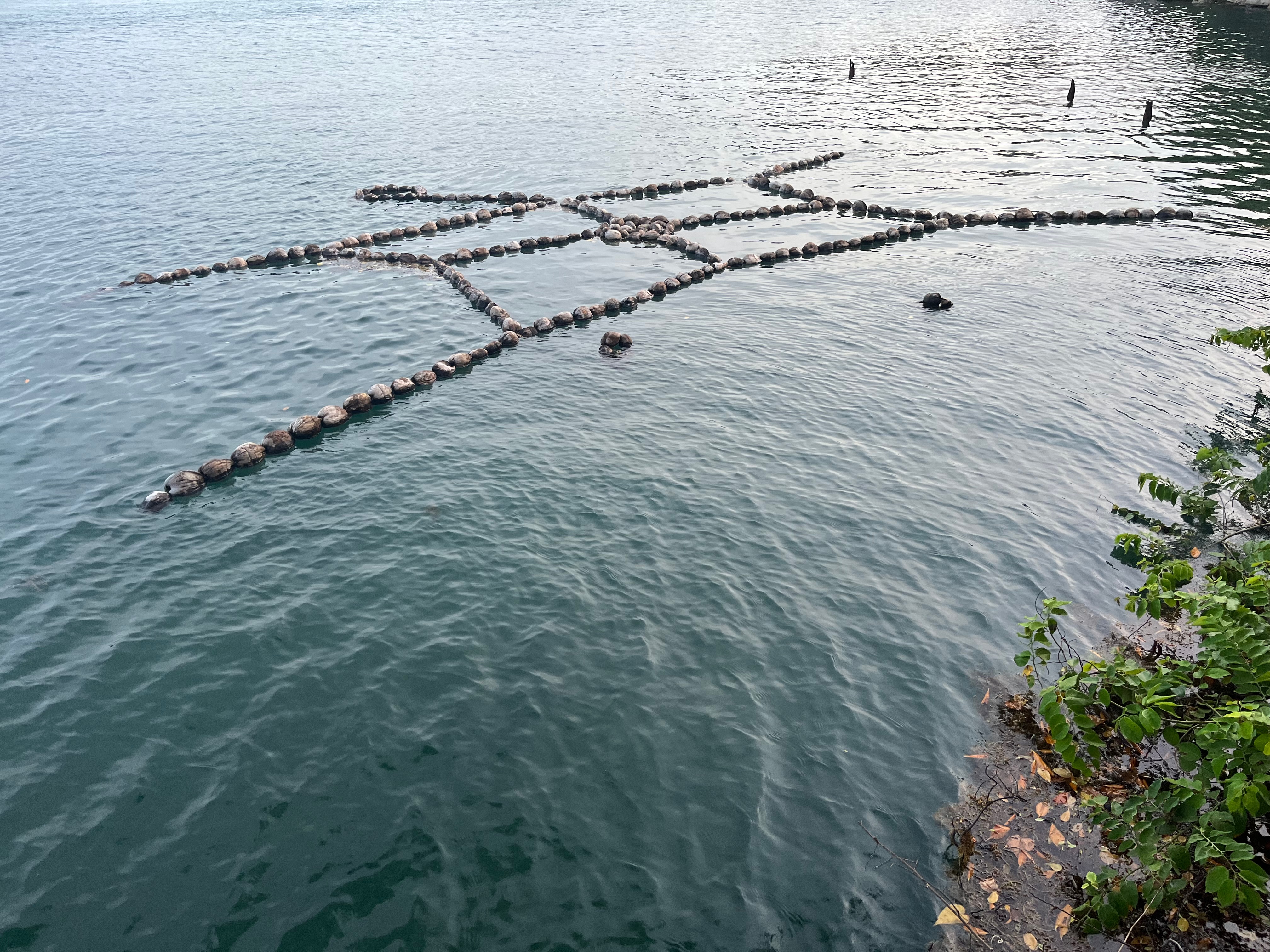
Por el Viento y La Corriente (Becoming Wind and Current) is a site specific project developed by La Vaughn Belle (b. Tobago, 1974. Lives in Christiansted, St. Croix. USVI) in Loíza as the result of research linking a history of maritime marronage of the hundreds of enslaved Africans who fled the island of St. Croix by creating dugout canoes or hijacking ships in their search for freedom. The title stems from the words of the governor of the then Danish West Indies in the early 1800's commenting on the northern trade winds and the ocean current that assisted those escaping to Puerto Rico by sea. Among the results of the project are this installation created with floating coconuts whose shape takes inspiration from descriptions of the physical tribal markings bore by fugitives who escaped bondage included in advertisements seeking their return as property. These markings, scars that reflected a cultural identity and heritage, are a lasting reminder of the uncrushable spirit of these freedom-seeking people. The coconuts, as the raw material for the sculpture, evoke the equally maritime migration of this plant, which originates in the Indian subcontinent, and was introduced to the Caribbean by Europeans in the 16th century, as well as its culinary, artisanal, and spiritual aspects. This sculpture is installed amongst mangroves, a natural sanctuary that was historically used as a maroon route. The piece is conceived as an offering to this history and those men and women.

Another aspect of the project consists of a video art piece that serves as a poetic investigation on the history of marronage and its implications today. Commissioned by MAC en el Barrio, a program of the Museo de Arte Contemporáneo de Puerto Rico, in collaboration with COPI (Coorporación Piñones se Integra, Inc.).

Friday, February 14, 2020

VISCO (Virgin Islands Studies Collective) co-authored article on the Queens of the Fireburn


This article is written in what can be described as the “post centennial” era, post 2017, the year marked by the 100th anniversary of the sale and transfer of the Virgin Islands from Denmark to the United States. 2017 marked a shift in the conversation around and between Denmark
and its former colonies in the Caribbean, most notably the increasing access of Virgin Islanders to the millions of archival records that remain stored in Denmark as they began to emerge in online databases and temporarily in exhibitions. That year the Virgin Islands Studies Collective, a group of four women (La Vaughn Belle, Tami Navarro, Hadiya Sewer and Tiphanie Yanique) from the Virgin Islands and from various disciplinary backgrounds, also emerged with an intention to center not only the archive, but also archival access and the nuances of archival interpretation and intervention. This collaborative essay, Ancestral Queendom: Reflections on the Prison Record of the Rebel Queens of the 1878 Fireburn in St. Croix, USVI (formerly known as the Danish West Indies), is a direct engagement with the archives and archival production. Each member responds to one of the prison records of the four women taken to Denmark for their participation in the largest revolt in Danish colonial history. Their reflections combine elements of speculation, fiction, black feminist theory and critique as modes of responding to the gaps and silences in the archive, as well as fining new questions to be asked.
in the largest labor revolt in Danish colonial history. Their reflections combin
e elements of speculation, fiction,
black feminitist theory and critique as modes of responding to the gaps and silences in the archive, as well as
finding new questions to be ask

See promo video below:


Here is a sample from my section of the article. I felt like I was the last leg on a relay team that comprised of the dream team. #ironsharpeniron

  1. A Queen by Another Name: Susanna Abrahamson aka Bottom Belly
Or 
I Am My Own Empire: Susanna Abrahamson aka Bottom Belly 
or
Queen Susannah and the Bottomless Imaginary of a Black Queen
Or
Queen Susannah and the Bottomless Imperial Imaginations of a Black Queen
La Vaughn Belle

My mother named me after a queen. She told me she had seen the name of a carnival queen in a newspaper in Trinidad and had liked it. I had forgotten to ask her if she had seen the name and held on to it, claiming it from then to be mine. Was I in her belly yet? Was I even a thought yet? Were there qualities about this queen she hoped I would embody? Or was it just the name, it’s look and it’s sound that drew her to place it upon me? My mother is no longer here for me to ask her these questions and it didn’t occur to me until much later in life that these were questions I might have even wanted answered. Hence this compact story of how I got my queen name was something I did not always know. But what I did learn very early on growing up in the Virgin Islands, first on St. Thomas and later on St. Croix, is that our queens were different from the ones in storybooks that lived in castles. Those queens were born. Our queens are made. Whether they be queens of pageants, carnivals, labor revolts or slave rebellions, through your own fashioning, determination, your own work and imagination you could lead yourself into a realm and become the kind of queen that was impossible to dethrone and impervious to invasion. Our queen means: you are your own empire. You rule yourself, your body, your destiny and even when that wasn’t entirely true due to history and circumstance, you believed it to be true, you moved as if it were true because you understood that life is the realm of fiction anyway.

Thursday, March 28, 2019

Chisholm Trail

I am so excited about having been selected as a finalist for the Shirley Chisholm monument. The voting is April 1, 2019 and as I prepare the last details of my presentation I am filled with honor and gratitude for having had the opportunity to reflect on this outstanding woman's legacy and life. This image pretty much summarizes what this process has been like for me. 


However, last year around this exact time I was also busy preparing for another monument project- I Am Queen Mary. I have taken so many of the things that I learned while working on that collaborative project and brought them into my process in developing this one. For one, how do you create a monument that is about a historical figure that can bring the audience into it? How do you shift the patriarchal and authoritative understanding of monuments to be more inclusive and more expansive? Furthermore, since my practice is rooted in a belief that art can be an investigative tool, a way to engage in dialogue, a platform for thinking and a means to develop knowledge, I wanted to create a project that would do just that while pushing the boundaries of what a monument to a person can be. 


Firstly, I wanted to invite the audience to be a part of the piece with the inclusion of several folding chairs and create a space of gathering and an ability to interact with the monument in various ways. This gesture reimagines her famous quote, "If they don't give you a seat at the table bring a folding chair" and locates it into a larger framework of mobility. This quote speaks to a type of mobility in terms of a flexibility of strategy. However, this strategy also connects to mobility in terms of a journey. It was important for me in reflecting on how does one image someone who lived to be eighty years old to also recognize her journey, her trail. I do that by representing five images of her from childhood to elderhood. They provide a connection to her from different entry points of her life and allow a more complex narrative about where she came from, who she was and where she hoped to be.


Additionally, I think that Chisholm's bold and historic run for the presidency speaks to larger issues of not only who can be the president of the U.S. or what it is to be an American, but also what is possible? What is possible in the promise that is the United States of America?  She challenged us to think about how this petite black woman with a Bajan accent marking her immigrant roots, could represent the promise of the United States both literally and symbolically and how her trail -to use her campaign slogan- could “bring U.S. together”. 

I did quite a bit of research for this proposal in various archives to not just understand her policies and personhood, but specifically her image as that was the only requirement the commission gave us- that her image needed to be in the monument in some fashion. After finding this striking photograph of her wearing the symbol of an eagle it made me think about alinging her with these same American symbols. Wearing an eagle pin she steps boldy into a reenvisioned version of the presidential seal encircled by fifty stars that represent the united fifty states. But there are outliers. As a Virgin Islander it was important for me to signal that the promise of the United States is not fully realized. Chisholm herself spoke of that throughout her campaign in reference to the lack of full political rights for all Americans. However, in my case as someone living in one of the five inhabited territories of the United States with unrealized full citizenship, I wanted to make a small gesture with the five stars that lie outside the union that we are still here advocating for our political rights as well. We too, like America herself, like Chisholm herself, are on a journey to a promise. The metal inlays of the stars and stripes in the floor become symbols of that journey and our unique paths as Americans. 

There were also some things about Ms. Chisholm that spoke to me uniquely. I grew up knowing that she had Bajan roots like I do. However, it wasn't until I began doing the research for the monument and happened upon my first video of her speaking that I realized she also carried the marker of an immigrant. Her very distinguishable Bajan accent that can be characterized as sounding like one has hot rocks in their mouth was the same cadence of my father, my aunt, my grandmother. There was immediately a different connection I had with her and it's what inspired me to want to have the sound of her voice in the monument. I wanted those, especially in the community that the monument is placed in, a community of mostly Caribbean immigrants, to be able to not just see, but hear themselves reflected. 

However there was something else, something unique to black womanhood that becomes evident when faced with the decision of how to image Shirley Chisholm-that of her hair. For many that choice may have seemed obvious as she was often imaged with her iconic wig. However, as I combed her archives I found some images of her when she did not wear that wig, like when at home with her husband, on vacation with him in Jamaica or in certain situations where the kind of respectability that particular wig provided was not needed. When I found the image of her wearing a turban and speaking at a Presbyterian church to an audience of mostly black women that image spoke to me. I knew that she may not have worn a turban on Capitol Hill, but I knew exactly what she was communicating and to whom when she wore that turban. I wanted to open up a conversation about representation and audience as she was very aware and deliberate about what she wore and how she presented herself. I believe the choice of the turban opens up that conversation. 

There are many many choices that go into making a proposal for a monument that will last for as long as this one is expected too. It is not just an exercise in looking back, but in considering the present moment and marking it, and signaling something for the future as well. I believe that monuments can encompass collective narratives and I think the best ones create a space for dialogue and find ways to invite you in. This has certainly been the hope with my proposed monument dedicated to the legacy of Shirley Chisholm. It is also my sincere hope that we may all be inspired by Chisholm Trail. 


Wednesday, March 27, 2019

SHE BUILT NYC: CITY UNVEILS FIVE PRELIMINARY ARTIST PROPOSALS FOR SHIRLEY CHISHOLM MONUMENT IN PROSPECT PARK


FOR IMMEDIATE RELEASE: March 27, 2019

Contact: publicaffairs@culture.nyc.gov; 212-513-9323

SHE BUILT NYC: CITY UNVEILS FIVE PRELIMINARY ARTIST PROPOSALS FOR SHIRLEY CHISHOLM MONUMENT IN PROSPECT PARK

Based on these proposals, a final artist will be selected in early April through the City’s Percent for Art program

Brooklyn, NY – Today, the City released five preliminary artist proposals for a new monument honoring Shirley Chisholm in Prospect Park, the first artwork being commissioned as part of the She Built NYC initiative to bring more monuments honoring women to New York City’s public spaces. The public is invited to comment on the proposals online at women.nyc through Sunday, March 31. 

“Following the Mayoral Monuments Commission report, we committed to expanding the people, stories, and voices represented in our public monuments,” said Cultural Affairs Commissioner Tom Finkelpearl. “We were thrilled to announce Shirley Chisholm as the first person honored, and we’re excited to get a first look at what these artists are envisioning for this lasting testament to Chisholm’s trailblazing achievements. We invite all New Yorkers let us know what they think and help shape this landmark contribution to NYC’s public space.”

"The contributions Rep. Shirley Chisholm made to this country are immeasurable," said Faye Penn, executive director of women.nyc. "The She Built NYC statue honoring this trailblazer is a way for New Yorkers to thank her for advocating in the halls of power on their behalf. We look forward to hearing feedback from the public and thank the artists for their moving representations of this American hero."  

“Shirley Chisholm, a true daughter of Brooklyn, born of West Indian immigrants who settled in Bedford-Stuyvesant, was one of this nation’s greatest dreamers. A monument of this magnitude, dedicated to the first person in 192 years to embody the triple threat of being Black, a woman, and a representative of Congress, is most deserving of this lasting recognition. It is long overdue,” said Brooklyn Borough President Eric Adams.

"I am absolutely delighted to see the preliminary renderings of the installation that will honor Shirley Chisholm in Brooklyn. It can't be said enough how truly groundbreaking and courageous Shirley was. Whether running for president or opposing the Vietnam War, Shirley stood by her convictions, not what was politically expedient. We all owe Shirley a huge debt of gratitude -- it is so very meaningful that she is the first woman to be recognized through the long overdue She Built NYC initiative," said Council Member Helen Rosenthal, Chair of the Committee on Women.

Shirley Chisholm is the first monument announced as part of She Built NYC, an initiative to construct public monuments honoring the New York City women who have changed history. The effort kicked off with an open call for nominations in June 2018, and from these public nominations, Shirley Chisholm was selected and announced in November 2018 in recognition of her role as a political trailblazer who was both the first black Congresswoman and the first woman to seek the Democratic presidential nomination. The monument is anticipated to be completed by the end of 2020 and will be installed at the Parkside entrance to Prospect Park in Brooklyn.

The five preliminary design proposals from the artists are (all images courtesy of the artists):

Firelei Báez
Artist Statement
The monument to Shirley Chisholm proposed by artist Firelei Báez is comprised of a series of hand-painted metal columns that collectively shape-shift into three respective portraits of the trailblazing legislator and first African American presidential candidate. Like a lenticular panel whose image changes when viewed from different angles, from each of three vantage points, this traversable forest of flower-like posts will transform into varying representations of Shirley Chisholm. As the viewer walks around the sculpture, the partial images painted onto each of the posts’ three sides will coalesce into distinct portraits when viewed from specific perspectives. Each of the three portraits represent a different aspect of Chisholm’s public role and accomplishments.

Báez creates Chisholm’s three representations incorporating hand-painted imagery tied to inherited Afrodiasporic narratives. Two of the portraits liken Chisholm’s characteristics to those of Orishas, human embodiments of elemental spirits from the Yoruba tradition, while the third incorporates the Pan-African flag. When viewed aerially, the beams of Chisholm’s monument are arranged into the form of Sankofa, the West African symbol of a bird which reaches back to move forward and construct our future.

The proposed monument will be an accumulation of hand-painted, vertical steel columns, each measuring approximately 10-15 feet in height and anchored into a poured concrete foundation covered with pavers. A point of inspiration for this sculpture’s form is the monument to Nelson Mandela in Howick, South Africa.


La Vaughn Belle
Artist Statement
This proposal reinterprets Shirley Chisholm’s famous quote, “If they don’t give you a seat at the table bring a folding chair” and positions it into a larger framework of mobility. This monument invites visitors to not only think about Chisholm’s personal journey from childhood to elderhood, but also the movement of a people and a nation. For what her historic run for the presidency challenges most is our imaginary of what is possible. Wearing a turban and an eagle pin, she steps boldly into a re-envisioned version of the presidential seal. She challenges us to think about how this petite black woman with a Bajan accent marking her immigrant roots, could represent the promise of the United States both literally and symbolically and how her trail -to use her campaign slogan- could “bring U.S. together”.

Tanda Francis
Artist Statement
While many were beginning to organize the fight for America to live up to its promise that "all men are created equal", Shirley Chisholm's trailblazing life prompted us to consider the equality of all of humanity.

Chisholm Trail Memorial is a bold and timeless dedication to Shirley Chisholm, supported by her own powerful words. Her inspiring quotes are embedded into the ground of the sidewalk leading to the Ocean Avenue entrance of Prospect Park. This trail tempers visitors to the mindset of this great woman as they approach her monumental bronze representation framed by vertical jets of water and light. Chisholm Trail is a colossal dedication which the people of New York City and the world will seek out and know of our commitment to honoring the women who helped build New York.

Mickalene Thomas
Artist Statement
Prospect Park is known as Brooklyn’s Backyard. The sculpture that inspires me is one that reflects the breadth of Shirley Chisholm’s impact and also illustrates her as a woman who was deeply in touch with the people of the Brooklyn community.

In the current political and cultural landscape, art is about accessibility and immersive experiences. Rather than portraying Shirley standing at a podium and speaking down to her audience, this model will instead show her rooted in the peoples’ space and speaking to their truths.

Shirley’s figure will be created at human-scale and seated at the viewers’ level so that audiences can engage with her. The car on which she’ll sit not only captures a moment in time, but it also emphasizes the social relationships of the community – this will be a space for people to congregate. The surrounding environment will have dual purpose benches/planters and in them the plant life will be selected to reference Shirley’s Caribbean heritage.

By employing a nontraditional sculpture to depict a nontraditional force, the monument is meant to highlight the fortitude of both Shirley Chisholm and the people she represents. This is ultimately about the visibility of everyone in the community.


Amanda Williams & Olalekan Jeyifous
Artist Statement
We have created a monument to Shirley Chisholm that celebrates her legacy as a civil servant who “left the door open” to make a space for others to follow in her path toward equity and a place in our country’s political landscape. Depending upon your vantage point and approach to the Ocean Avenue entrance, you can see Ms. Chisholm’s silhouette inextricably intertwined with the iconic dome of the U.S. Capitol building. This mashup symbolizes how she disrupted the perception of who has the right to occupy such institutions and to be an embodiment for democracy. This trailblazing woman was not diminutive. This monument represents how Chisholm’s collaborative ideals were larger than herself. The ground plane is carved in a shape that mimics the amphitheater like style of Congressional seating. Each seat pays homage to those who came after Ms. Chisholm as well as leaves room for those who have yet to come.

Images of the five proposals are available for download here. All images are courtesy of the artists. 

These five artists were selected at an initial Percent for Art panel in January 2019. Following the public feedback period for these preliminary proposals, a second Percent for Art panel will select a finalist, who will then refine the design before presenting to local community boards and submitting it to the Public Design Commission later this year. Up to $1 million will be available for the commissioning of the monument.

This monument will be installed as a part of Prospect Park Alliance’s $9.5 million restoration of the Parkside and Ocean Avenue perimeters and entrance to the park, which is made possible through $6.7 million in funding by Mayor de Blasio, $2 million in funding from Borough President Eric L. Adams and $750,000 in funding from Council Member Dr. Mathieu Eugene. This large-scale restoration by the Alliance will include new sidewalks and paving, new historic lighting and street furniture, the planting of new trees and the addition of a protected bike lane.

She Built NYC started with an open call asking the public to nominate women, groups of women, or events involving women that significantly impacted the history of New York City. Through the women.nyc website, the public submitted nearly 2,000 nominations. Ninety-eight percent of respondents said they would like to see a woman honored who was committed to social reform or justice. The most frequently used word in the submissions was “first,” followed by “leader” and then “advocate.” An advisory panel with individuals representing a broad range of expertise and backgrounds helped refine the public submissions list and provided recommendations to the City.

Earlier this month, the City announced the next four women who will be honored with public monuments, bringing the total of monuments initiated through She Built NYC to five, with one in each borough. She Built NYC is an initiative of women.nyc, which was launched in May 2018 by First Lady Chirlane McCray and former Deputy Mayor Alicia Glen to ensure that New York remains the best city in the world for women to succeed.

The launch of She Built NYC followed a report issued by the Mayoral Advisory Commission on City Art, Monuments, and Markers in January 2018, which led Mayor de Blasio to order actions on a number of its recommendations. Most critically, the report called for adding more voices and broader representation to the City’s collection of public art to better reflect its diverse history. Other efforts underway in response to the Monuments Commission report include “Beyond Sims,” which is commissioning new artwork for the former site of the J. Marion Sims statue along the edge of Central Park in East Harlem. The statue of Sims was removed in April 2018 following years of community advocacy.

About women.nyc
When women succeed, the greatest city in the world becomes even better. Women.nyc is a groundbreaking initiative that not only inspires women to advance their careers, but also provides them with the real tools they need for success. From free expert legal advice, to networking and mentorship, to financial assistance, women.nyc offers a growing portfolio of resources for working women. Join women across the five boroughs and make your #nycpowermove with the help and support of women.nyc.

About Percent for Art
Since 1982, New York City's Percent for Art law has required that one percent of the budget for eligible City-funded construction projects be spent on public artwork. Managed by the City’s Department of Cultural Affairs, the Percent for Art program has commissioned hundreds of site-specific projects in a variety of media—painting, new technologies, lighting, mosaic, glass, textiles, sculpture, and works that are integrated into infrastructure and architecture—by artists whose sensibilities reflect the diversity of New York City. Learn more at www.nyc.gov/percent. 


Saturday, December 1, 2018

Neither Subject Nor Citizen

I wish I had known it then, but I didn't. I didn't know when I lived in Harlem in the 1990's the role that Virgin Islanders played in developing the radical movements in the 1920's and 30's. I wish I had known that when I was walking the streets of Lenox that I was walking in the footsteps of some of the greatest organizers and debaters and agitators who wrestled publicly with ideas of democracy, citizenship, blackness and liberation. I am beginning to hear their echoes as they reverberate from the pages, the letters, the dance tickets, the photographs, the posters that I held while on my first trip to the Schomburg Center for Black Culture. 


How could that have been my first time going there? This amazing collection started by Arturo Schomburg who lived for a time in St. Croix with his Crucian family. Arturo Alphonso, son of Mary Joseph, was also a Virgin Islander, a Portocrucian, a Crucianrican a part of the long historical and familial ties between the two islands. I didn't know this either. 

We are a culture of unremembering and this process is our colonial legacy and so in turn the decolonizing will begin there, in the archives, sifting through letters of the American West Indies Ladies Society. Touching and reading the handwritten notes by an elderly woman in St. Thomas thanking them for sending her financial support, letters from various Virgin Islands groups inviting one another to dances and public debates, letters asking for solidarity to protest lynching, to fight for the rights of porters and domestics. There are nuances in the correspondence between these organizations. You can see that there are conflicts in the ways that one organization asks the other to please be in attendance in the event as to not embarrass them, or that the women's organization tends to very gendered roles in organization, bringing food, selling tickets, etc...However, what my first deep dive into the archives around Virgin Islanders in the Harlem Renaissance left me most with was the feeling of how they claimed public space as a space to debate ideas, signify meaning and presence. It is from this first encounter that I came up with the title for an exhibition, "When the jungle creeps up unto the skyscrapers". This is commentary by a journalist describing one of the parades in Harlem. It comes from a very racialized imaginary of course. But it's also signaling a claiming of space through sound and movement that I find fascinating and look forward to explore more during the rest of my fellowship.

To read more about my project: Neither Subject Nor Citizen, my artistic research project at the Social Justice Institute at the Barnard Center for Research on Women see here. 


Monday, October 29, 2018

Revisiting my speech at the inauguration of I Am Queen Mary, March 31, 2018

I recently received an email by a young artist in Sweden who did a project where he used a copy of the speech I gave on a t-shirt project. It was very serendipitous for me as at the time I received the email I was at the Schomburg Center archives in NY researching speeches by Virgin Islanders in the Harlem Renaissance. 

La Vaughn Belle Inauguration Speech I Am Queen Mary, March 31, 2018

Greetings!
My name is La Vaughn Belle and I am a visual artist from the Virgin Islands. I have noticed that in the city of Copenhagen there are many sculptures. There is a sculpture of King Frederik V, King Frederik VI, King Frederik VII, King Christian X, Princess Marie, Andreas Peter Bernstorff, Emil Christinas Hansen, Hans Christian Andersen, 
Søren Kierkegaard, Peter Griffenfeld, Joan of Arc, Salvador Allende, David, Thor, Diana, Aphrodite, Moses, Neptune, a drunken faun, a neapolitan fisherman, a blind girl, a blind boy. There are sculptures of mermaids, a cyclops, elephants, two lions, polar bears, a walrus, a snake and a troll. Quite a cast of characters. Not one of these sculptures have represented the African people who were brought to colonies in the Caribbean whose labor and lives helped to build this city. Not until now.

I Am Queen Mary has been an ancestral calling to remember. They called and we responded. Each in our different ways. My journey into this project took a turn when I was sitting on the steps of my studio three years ago and I noticed some coral stones on the ground near the ruins of an outhouse. They were beautiful, but I wondered about why they had straight edges as if manipulated by someone’s hand. That is when I had a sudden remembrance of the history of these stones. I recalled how the enslaved Africans would be sent into the ocean during the low tide to cut them out of the reefs. The corals were then used to form the foundations of many of the colonial era buildings in our towns. However their labor was invisible. We often look upon this buildings as Danish, because of the Danish bricks imported from Flensburg that are the most visible. But these structures are not Danish alone and this history is not Danish alone. These coral stones in the base of I Am Queen Mary made a journey similar to those were taken from the African continent to get here- in ships, over the course of months and across the Atlantic. These stones are their testimony.

Although Mary Thomas was a real person, it is unknown today what Queen Mary actually looked like, so with many icons we have projected our imagination unto her. As artists we created an allegorical representation of her in which the figure is a hybrid of our two bodies modelled using 3D scanning technology. In doing so we have created a new woman that can serve as a bridge between our bodies, nations and narratives. The torch and cane bill in each of her hands reference the weapons used by the colonized in their struggles for freedom. Her seated pose recalls the iconic 1967 photograph of Huey P. Newton, founder of
the Black Panther Party. The plinth incorporates coral cut from the ocean by enslaved Africans gathered from ruins of the foundations of colonial era buildings on St. Croix. Together these symbols create a multilayered, new narrative that promotes the idea that whether enslaved or free the colonized were agents of their own humanity. They fought, they resisted in small and large ways that are often invisible and unaccounted for in the colonial records. They demanded that the colonial system acknowledge their humanity and to be honest, they didn’t always win. Queen Mary herself, along with the three other women that she fought with, were imprisoned for several years in Denmark for protesting against unacceptable living and working conditions. Many people died under those conditions. Some were worked to death or were killed for defying being worked to death. Their labor paid for an immense amount of wealth that was generated for the Danish kingdom which throughout time has encompassed colonised territories in Norway, Sweden, the Faroe Islands, Iceland, Greenland, and parts of India, Germany and the Caribbean. Despite the vast effects of Denmark’s colonial impact in the Caribbean, the visual reminders in Denmark are few. “I Am Queen Mary” will serve as a reminder to that history. They called and we responded.

“I Am Queen Mary” is a project that came out of two individual artists, but just like Queen Mary and the other women of the Fireburn labor revolt, we came together to work on making a change. We were not invited or commissioned to do this monument. We pushed into the public space and claimed it to transform the narrative around the colonial histories that impact all of us. The ancestors called and we responded.

It is a great honour to welcome the new Queen in town.

VI Studies Collective (VISCO) Founding Statement


I recently got back from NYC and among many things had the opportunity to have a 2 day working meeting with these amazing women. It's on!!!!!


VI Studies Collective (VISCO) Founding Statement
2018

St. Croix, St. Thomas, and St. John, the group of islands currently known as the United States Virgin Islands (formerly the Danish West Indies) are crucial spaces for thinking through questions of sovereignty, personhood, and belonging. We are a group of academics, artists, and activists who are committed to centering the Virgin Islands as a site of inquiry and theorization beyond a notion of utopia or space that is not meaningfully occupied. As founders of VI Studies, we situate this field as a multidisciplinary framework through which we—and others—are able to study and understand the Virgin Islands. Our conceptualization of the U.S. Virgin Islands allows for various connectivities with Puerto Rico and the British Virgin Islands. 

We are committed to centering the Virgin Islands as the intellectual, cultural and political center of our inquiry. We engage with other sites, including Denmark, the United States, and the wider Caribbean and African Diaspora secondarily but vitally. Given the radical intersectional politics that drive our work, VISCO aims to be attentive to the processes by which race, gender, class, sexuality, age, ability, and nationality frame the U.S. Virgin Islands and the power dynamics therein. We are committed to examining via intellectual inquiry, we are committed to creation via artistic practice, and we are committed to radical pedagogical interventions.

The founding of VI Studies began in 2017 as a series of conversations between LaVaughn Belle, Tami Navarro, Hadiya Sewer, and Tiphanie Yanique. We, the VI Studies Collective (VISCO), are centrally concerned about the erasure of the Virgin Islands from larger discourses and the lack of resources to attend to our community’s needs, most notably the silences surrounding the territory's continuous colonial subjection, the lack of cultural institutions to preserve Virgin Islands history, and the ecological precarity demonstrated by Hurricanes Irma and Maria. From this set of discussions grew the formalized working group, VI Studies. As a group of Afro-Caribbean women, we are committed to a practice of collaborative production and inclusion. We explicitly engage in collective knowledge production and seek out partnerships at all levels in ways that are beneficial to all parties, including citational practices and resource sharing.  We have undertaken the project of carving out this area of inquiry in order to bring together the decades of research that has already been undertaken by scholars and cultural workers, both within institutions and independently. 


La Vaughn Belle: A Haunting Between Us